How to stay human when the machines start writing
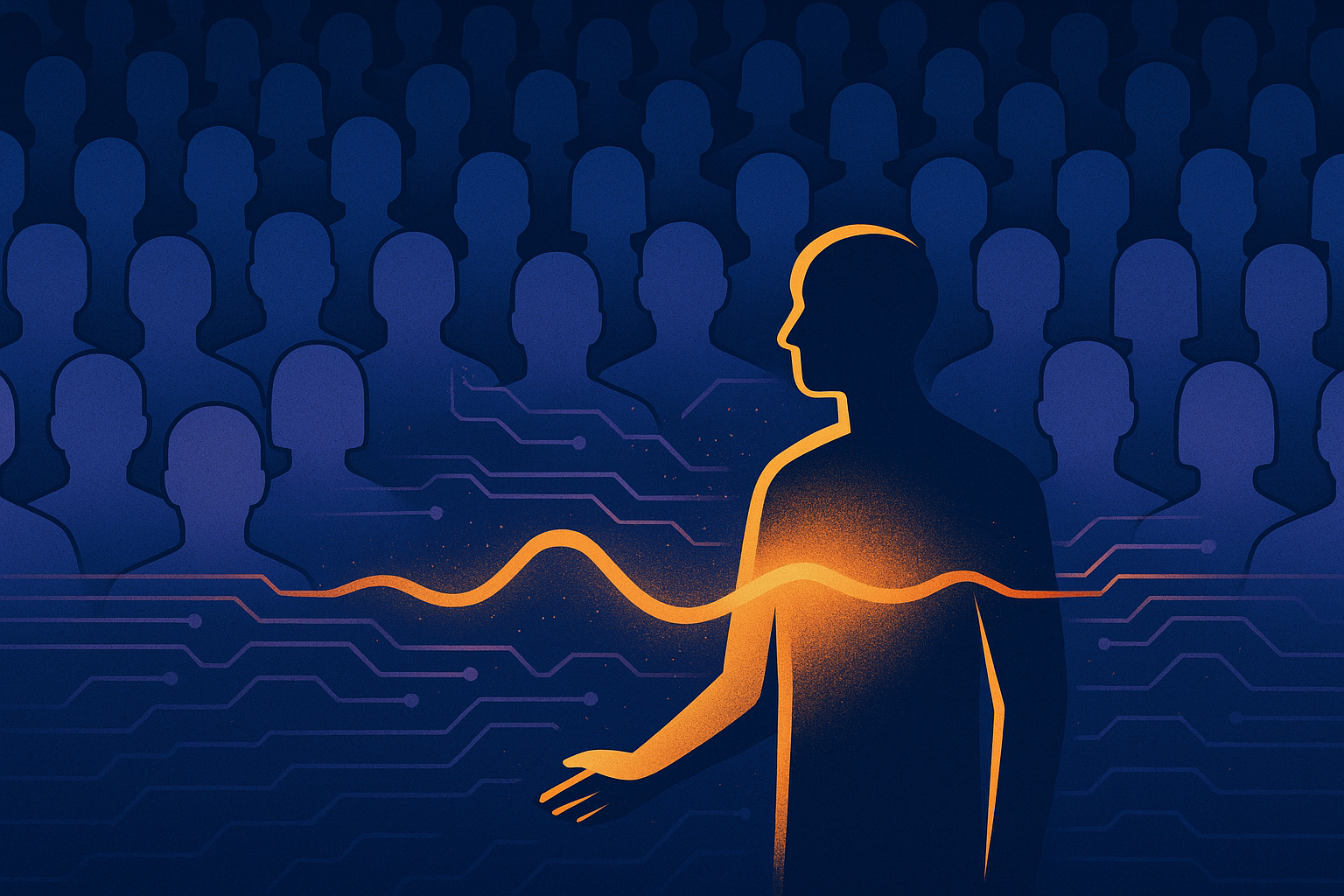
Why authenticity and the power of ideas will define the next era of thought leadership
The big ideas
1. Why does thought leadership matter more than ever in the age of AI? Because when technology floods the world with content, human perspective becomes the rarest resource.
2. What separates real thought leaders from content producers? Integrity and intention. True thought leadership isn’t about volume, it’s about having something worth saying.
3. How can leaders keep their humanity when using AI? Start with conviction, not convenience. Use AI to clarify your ideas, not to create them.
4. Why will authenticity outperform volume? Audiences can sense when thinking has depth. Fast content may fill feeds, but real ideas build followings.
5. What’s the one constant through every communication revolution? Tools change. The power of original thought doesn’t.
64,000 years ago, a heavy-set figure, illuminated by the flicker of a small fire and a final ray from the setting sun, dips their hand in pigment and presses a palm against the cave wall. We don’t know why they did it. But we do know that behind the action was an idea. That moment turned an invisible thought into something shared.
Over the millennia that followed, creators and writers have found ever more advanced ways to convey thought and develop ideas. Pigment, stylus, quill, printing press, typewriter, PC, spell check, grammar software, and now AI. Each has redefined how we communicate.
But these technological leaps also democratised expression. From a handful of elders and clergy, to scholars and scribes, to students, office workers, bloggers, and AI-enabled creators, access to new technology has allowed more voices than ever to share and develop ideas.
So why is AI-enabled content so controversial, especially in thought leadership?
Everyone is a ‘thought leader’
Democratisation means more production and greater volume. Want a blog on content marketing in real-estate? Choose your LLM, pick a tone, and you have a passable draft. Marketers do this on a spectrum: some are deep-diving into prompts, others make quick requests. Output (a lot of it slop) by the bucketload.
But is this really any different from every other shift in history? Once, newspapers ruled the world. Thousands of publications, each with rhetoric, ads, and half-baked takes. A few that most clearly represented the people they served survived. Later came spell check and grammar tools for blog writing and content creation. Each let more people than ever create more content, faster.
AI follows the same pattern, only on a larger scale. The best work still comes from those who have something to say and the discipline to say it well. People will tire of volume and seek clarity again. We’re simply moving through another cycle.
Keep your human nature in check
With that being said, here are some ways to keep your humanity, without missing out on the benefits of AI:
Start on paper: take a pen and scribble down your thoughts and ideas. Develop one thread you like the most and use it as the basis for an AI prompt.
Collaborate, don't delegate. Create a GPT or agent that works with you, not for you. Bounce ideas, ask for alternative views, and challenge the output.
Develop an outline, not a final asset. Develop something that feels uniquely yours through natural discourse. Then write it yourself!
Enjoy the process. Use your outline but allow yourself tangents, blind alleys, and detours. You can write the originally intended blog later.
Proof your content once, then edit with AI. First, self-edit; this keeps your sense of control. Then, ask AI to act as your content editor, trained on your style guide. Instruct it not to rewrite your voice.
Don’t let AI erode your integrity
Everyone works differently, but we all know the frustration when your work stops feeling like your own.
Keep your voice. Used well, you’re not just creating content, you’re adding another idea to a 64,000-year-old tapestry of interconnected thought. The same spark that once turned an invisible thought into a handprint on a cave wall still drives every meaningful act of communication today.